Blog

Brokers for Algorithmic and EA Trading – Latency, VPS Integration, and API Access Compared

Brokers for Algorithmic and EA Trading – Latency, VPS Integration, and API Access Compared

Algorithmic trading can significantly enhance your trading strategy, but the choice of broker is vital. You need to consider factors like latency, which affects execution speed, VPS integration for reliable connectivity, and API access that allows for custom solutions. Understanding how these elements impact your trading performance will empower you to select the best broker for your needs, ensuring your algorithmic and expert advisor (EA) trades operate at peak efficiency.Understanding Algorithmic Trading Definition of Algorithmic Trading Algorithmic trading involves using automated systems and predefined rules to execute trades in financial markets. These systems can analyze market conditions, identify trading opportunities,…
Read More
How Forex Brokers Handle Corporate Actions on CFDs – Dividends, Rolls, and Adjustments

How Forex Brokers Handle Corporate Actions on CFDs – Dividends, Rolls, and Adjustments

Most traders are unaware that corporate actions can significantly impact your Contracts for Difference (CFDs). Understanding how dividends, rolls, and adjustments are handled by your forex broker is crucial for effectively managing your trading strategy. You might encounter unexpected changes to your positions based on these actions, which can lead to both risks and opportunities for profit. By grasping these concepts, you can better navigate the complex landscape of forex trading and make more informed decisions. Understanding Corporate Actions in Forex Trading Definition of Corporate Actions Corporate actions are events initiated by companies that impact their stock, including changes in…
Read More
Offshore Forex Brokers Explained – Real Risks Behind High Leverage and ‘No Regulation’ Marketing

Offshore Forex Brokers Explained – Real Risks Behind High Leverage and ‘No Regulation’ Marketing

You may be tempted by the promise of high leverage and the appeal of trading with offshore forex brokers that tout minimal regulation. However, it’s vital to understand the real risks associated with these platforms, including potential losses that can exceed your initial investment. The allure of less oversight can lead to fraud, inadequate consumer protections, and severe risks that you may not fully comprehend. Before engaging with these brokers, equip yourself with knowledge about their operations and the potential consequences of your trading decisions. Understanding Offshore Forex Brokers Definition of Offshore Forex Brokers Offshore Forex brokers are typically entities…
Read More
Stop-Loss Placement – Structure-Based Stops vs Volatility Stops (with examples)

Stop-Loss Placement – Structure-Based Stops vs Volatility Stops (with examples)

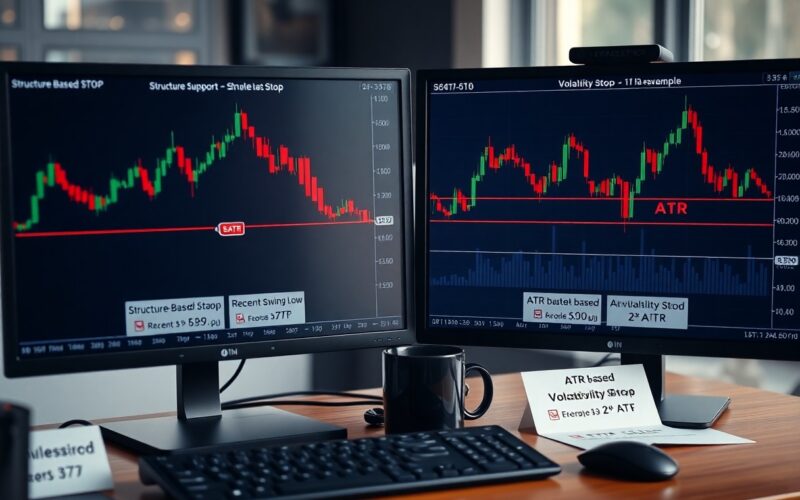
Most traders rely on guesswork, but you can improve your risk control by choosing between structure-based and volatility stops: structure-based stops sit beyond swing highs/lows - e.g., place your stop just below the prior swing low - giving logical trade invalidation, while volatility stops use ATR multiples - e.g., 2× ATR - to avoid market noise. Avoid placing overly tight stops because they can be hit by normal price oscillation, costing you trades and capital.Understanding Stop-Loss Orders Definition of Stop-Loss Orders You place a stop-loss order to instruct your broker to exit a position once the market hits a specified…
Read More
Base Currency vs Quote Currency – The One Concept That Fixes Most Beginner Mistakes

Base Currency vs Quote Currency – The One Concept That Fixes Most Beginner Mistakes

Most beginners confuse which currency moves against which, causing bad entries and risk miscalculations; once you grasp that the first currency is the base and the second is the quote, you can read price direction and size positions correctly. This single distinction gives you the power to avoid costly errors, interpret quotes, and set accurate stop-losses so that your trades reflect your intent rather than guesswork.Understanding Currency Pairs What is a Currency Pair? Pairs express a relative price: the first currency is the base, the second is the quote, so EUR/USD = 1.1100 means 1 EUR costs 1.1100 USD. You…
Read More
Partial Take-Profits and Trade Management – A Quant Framework for Discretionary Traders

Partial Take-Profits and Trade Management – A Quant Framework for Discretionary Traders

Framework for partial take-profits helps you blend quantitative rules with discretionary judgment so you can scale out of positions, lock in gains, and manage exposure; by defining clear size, price and time rules you improve risk-adjusted returns and consistency, while being aware that misapplied scaling can amplify tail risk and transaction costs if you retain oversized residual positions.Understanding Take-Profits Definition of Take-Profits You set a take-profit as a predefined level where you exit a trade to realize gains, typically via a limit order or an automated exit rule. For example, if you buy at 100 with a 5-point stop (95),…
Read More
How to Avoid Overfitting – Robustness Tests Every Retail Trader Can Do

How to Avoid Overfitting – Robustness Tests Every Retail Trader Can Do

There's a persistent risk of overfitting when you optimize strategies on historical data; to protect your capital you should run simple, repeatable robustness tests such as out-of-sample validation, walk-forward testing, parameter-sensitivity scans and randomization checks to expose data snooping and curve-fitting, ensuring your edge survives live markets. Most traders unknowingly optimize to noise, so you must run simple, repeatable checks that reveal fragility and preserve your real performance: out-of-sample testing and walk-forward analysis, parameter sensitivity and Monte Carlo to expose dangerous overfitting, and scenario/stress tests to confirm a robust, tradable edge you can trust in live markets.Understanding Overfitting What is…
Read More
What Moves Forex? The 9 Core Drivers (Rates, Growth, Inflation, Risk, Flows)

What Moves Forex? The 9 Core Drivers (Rates, Growth, Inflation, Risk, Flows)

There's a framework of nine drivers that determine currency moves, and you must weigh how interest rates, economic growth, and inflation interact with market risk and capital flows to forecast direction; this post gives you practical tools to assess monetary policy, PMI data, price pressures, investor sentiment and cross-border flows so you can align your trades with macro momentum.Understanding the Forex Market What is Forex? Forex is the global market where you exchange one currency for another; it averages about $7.5 trillion a day in turnover and operates around the clock during the business week, so you can trade virtually…
Read More
How Forex Sessions Really Work – London-NY Overlap, Liquidity, and Trap Hours

How Forex Sessions Really Work – London-NY Overlap, Liquidity, and Trap Hours

Over the London-NY overlap, sessions concentrate liquidity and create your best chances for clear trends, but they also raise volatility and the risk of trap hours where stops are hunted and slippage widens; you need a plan for trade size, order placement, and session timing to capture the upside while avoiding sudden reversals and false breakouts.Understanding Forex Sessions The Four Major Forex Trading Sessions You trade across four primary sessions: Sydney (Asian start), Tokyo (Asian/Asia-Pacific), London (European), and New York (North American). Typical UTC windows used by many traders are roughly Sydney 22:00-07:00 UTC, Tokyo 00:00-09:00 UTC, London 08:00-17:00 UTC,…
Read More
Currency Correlations 101 – When EURUSD, GBPUSD and DXY Move Together (and When They Don’t)

Currency Correlations 101 – When EURUSD, GBPUSD and DXY Move Together (and When They Don’t)

Forex correlations link EURUSD, GBPUSD and the DXY through flows and risk sentiment; you'll learn how a strong positive correlation can amplify moves, why divergences often signal elevated risk, and when a rising DXY compresses majors, so you can adjust positions, manage your exposure and spot setups that run counter to headlines.Understanding Currency Correlations Definition of Currency Correlation You measure currency correlation most commonly with the Pearson correlation coefficient, which ranges from -1 (perfect inverse) to +1 (perfectly aligned); values above +0.8 indicate strong positive co-movement, values below -0.8 indicate strong negative co-movement. Using rolling windows - for example 30-day…
Read More