


Traders must evaluate regulation tiers because they change costs, access, and safety for your trading. This guide explains how protections and leverage limits vary between tiers, compares FCA, ASIC and CySEC frameworks and highlights that FCA/ASIC oversight typically means stronger consumer protection and capital requirements, while offshore platforms often carry higher counterparty risk and limited recourse, so you can choose platforms aligned with your risk tolerance and trading objectives.
Understanding Regulatory Tiers
Definition of Regulatory Tiers
You’ll typically see three practical tiers: top-tier regulators (FCA, ASIC) that enforce strict client protection rules, mandatory client-money segregation and public enforcement; mid-tier EU/EEA regulators (CySEC historically) that offer passporting under MiFID but have had a wider range of supervision intensity; and offshore jurisdictions (Seychelles, Vanuatu, Belize) that provide fast licensing, higher allowable leverage and minimal investor protection. For example, the FCA’s framework ties into the FSCS safety net of £85,000, while Cyprus’s Investor Compensation Fund provides up to €20,000-offshore licences generally provide no comparable compensation.
When you compare requirements, top-tier firms must publish audited accounts, meet capital adequacy tests, comply with AML/CTF standards and submit trade reporting; mid-tier firms often meet similar rules but with more variance in enforcement intensity; offshore firms usually face lower capital requirements and fewer transparency obligations, which can translate into materially different operational behaviour by brokers.
Importance of Regulatory Frameworks
You rely on regulatory frameworks to set the baseline for what a broker must do: segregate client funds, maintain minimum capital, support dispute resolution and apply product rules such as leverage limits and negative balance protection. For instance, ESMA-derived measures kept retail CFD leverage caps at around 30:1 for major FX, and the FCA retained similar limits post-Brexit-those rules materially change your margin calls, stop-outs and worst-case loss scenarios.
Differences in frameworks also determine your practical recourse. Under a strong regulator you have transparent complaint routes, public enforcement records and potential compensation if a firm fails; under weaker regimes you often have only contractual remedies, which can be slow, costly or ineffective. That means the same trade executed with two brokers can carry very different real-world risk even if spreads and commissions look similar.
More precisely, regulatory rules shape product availability and pricing: brokers under top-tier regimes commonly restrict high-risk products (binary options are banned for retail in many jurisdictions) and limit leverage, while offshore brokers advertise 500:1 or higher leverage and quicker account opening-trade-off being that you lose formal investor protection and effective enforcement.
Overview of Regulatory Bodies
The FCA enforces strict conduct and prudential rules, requires client money segregation, keeps an online register and links to the FSCS (£85,000 cover). ASIC focuses on market integrity and consumer protection, has used product intervention (for example, retail bans on binary options) and requires an Australian Financial Services Licence for domestic operations; it also pursues enforcement actions and disgorgement. CySEC operates within MiFID, historically offered a gateway to EU clients via passporting and supports an Investor Compensation Fund (€20,000), but has tightened supervision and increased fines in recent years.
Offshore regulators such as those in Seychelles, Vanuatu or Belize issue licences with lower capital and disclosure thresholds, which speeds onboarding and lets brokers offer higher leverage and looser margin practices-but with limited or no investor compensation, weaker enforcement and higher counterparty risk. That makes jurisdiction checks and published enforcement histories one of the most important parts of your due diligence.
More detail you should act on: always verify a licence number on the regulator’s public register, review the regulator’s enforcement page for actions against the broker, confirm whether client funds are segregated and whether negative balance protection and leverage caps apply to your account type; if the broker asks you to elect “professional” status, know that grants access to higher leverage but also removes many retail protections.
Overview of Major Regulatory Authorities
Financial Conduct Authority (FCA)
Under the FCA, firms offering retail leveraged products face some of the strictest controls in the world: since 2018 the UK adopted leverage caps similar to ESMA’s rules (maximum 30:1 for major FX pairs, lower for other asset classes), and the regulator implemented a ban on the sale of crypto-derivatives to retail customers (implemented Jan 2021). You’ll also see mandatory client money segregation, clear disclosure rules, mandatory negative balance protection for retail clients in many product lines, and the Senior Managers and Certification Regime (SM&CR) that pins accountability to individuals.
The FCA backs retail clients with the Financial Services Compensation Scheme (FSCS up to £85,000 per eligible person per firm) and a heavy enforcement appetite – firms can expect multi‑million pound fines, public censures, and permission revocations. For you as a trader that means safer corridors and predictable redress, but also fewer exotic products, tighter leverage, and sometimes wider spreads as firms absorb compliance costs.
Australian Securities and Investments Commission (ASIC)
ASIC regulates via the Australian Financial Services Licence (AFSL) regime and has broad product intervention powers that it has used actively: it banned the sale of binary options to retail clients and applied restrictions on marketing and product features for CFDs. You’ll find ASIC places strong emphasis on fair marketing, disclosure, and anti‑money laundering controls, and it publishes enforcement outcomes and warning lists publicly to protect consumers.
Because ASIC can move quickly with targeted bans and enforcement, brokers operating under an AFSL often show robust compliance frameworks and clear dispute routes through the Australian Financial Complaints Authority (AFCA). If you trade under an Australian entity you generally get transparent reporting and a local complaints pathway, though some product offerings (especially high‑leverage retail CFDs) have been narrowed over recent years.
Additional detail: ASIC’s approach leans toward active supervision and deterrence – you’ll see regular surveillance, licensing refusals or cancellations where standards slip, and public enforcement that aims to curb aggressive sales practices; that environment favours traders who prioritise regulatory certainty over ultra‑high leverage.
Cyprus Securities and Exchange Commission (CySEC)
CySEC oversees many EU‑facing retail brokers under MiFID II, which allows firms registered in Cyprus to passport services across the EEA – a major reason many FX/CFD brokers set up there. You’ll encounter EU rule alignment (including client segregation, reporting, and application of ESMA leverage caps), and CySEC enforces an Investors Compensation Fund that can pay up to €20,000 per investor in qualifying cases.
Historically CySEC was seen as more permissive than the FCA or ASIC, but since 2018 it has tightened supervision, increased fines, and improved AML checks; you may still find lower operating costs for brokers and a broader set of product offerings compared with the UK, balanced against a regulatory authority that is still building a tougher enforcement track record.
Additional detail: if you choose a CySEC‑authorised firm you get EU passporting and consumer protections under MiFID, yet you should check the firm’s enforcement history and whether it has robust client fund segregation and audited accounts – those practical checks matter as much as the licence on paper.
Offshore Regulations
Jurisdictions like Belize, Seychelles, Vanuatu, Marshall Islands and Labuan typically offer minimal capital requirements, rapid licensing, and permissive product rules – brokers there often advertise leverage up to 1:500 or even 1:1000, permissive bonus schemes, and access to crypto derivatives. For you this can mean faster account opening and access to higher‑risk strategies, but also very limited legal recourse, no investor compensation schemes, and higher fraud risk if the operator misbehaves.
Where offshore can look attractive on price and product, the trade‑off is enforcement: regulators in those jurisdictions rarely conduct rigorous on‑site supervision, cross‑border cooperation is weak, and recovery of client funds is often impractical. You should factor in the added counterparty and jurisdictional risk when weighing cost versus protection.
Additional detail: if you elect to use an offshore broker, insist on independently audited financial statements, verified segregated accounts, a clear complaints/escalation path, and third‑party custody arrangements – lacking those you expose your capital to materially higher operational and recovery risk.
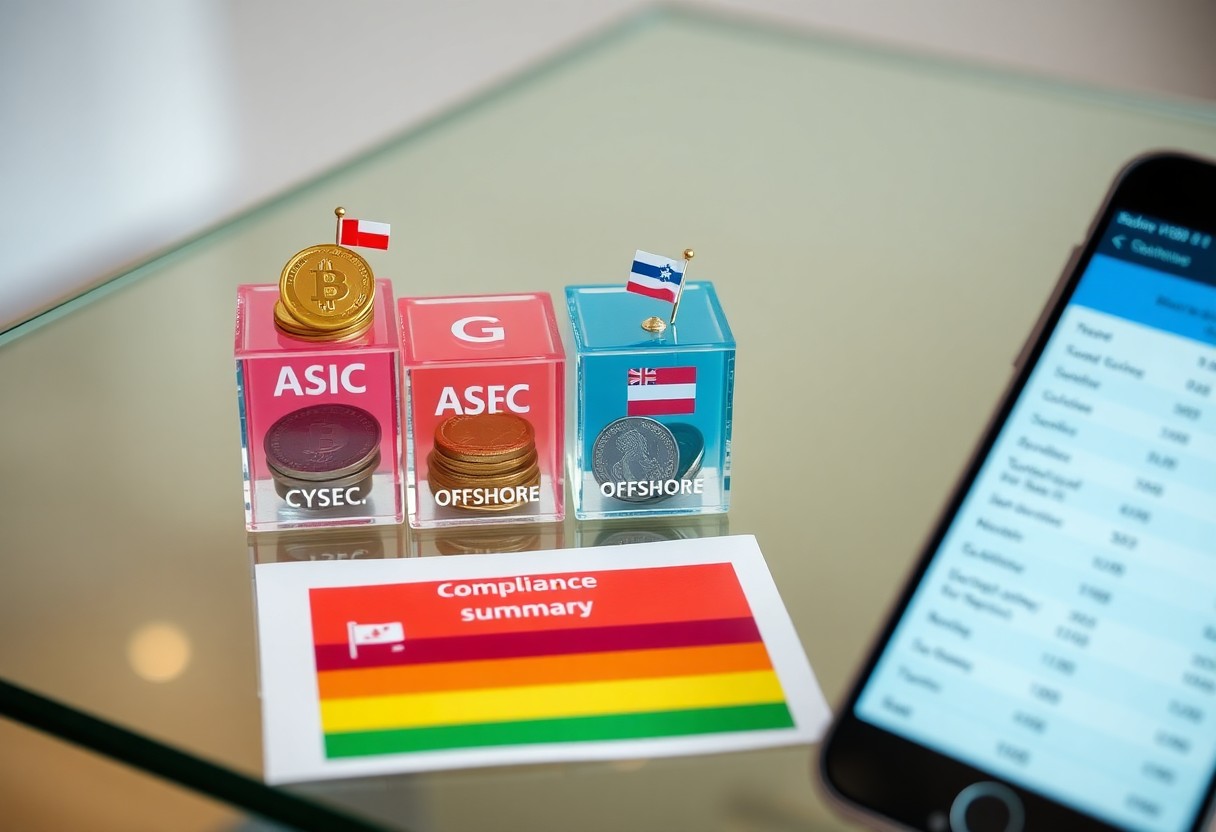
Comparison of Regulatory Approaches
Quick comparative breakdown
| FCA (UK) | You get strict retail protections: ESMA-style leverage caps (e.g., 30:1 for major FX), mandatory negative balance protection and segregated client accounts. Compensation via the FSCS covers eligible clients up to £85,000 if a firm fails. Reporting and capital rules are robust, with regular prudential returns and active enforcement. |
| ASIC (Australia) | You face strong licensing controls (AFSL) and a litany of enforcement actions against misconduct; ASIC has banned binary options for retail and tightened CFD marketing. Client-money segregation, AML/KYC and dispute referral to AFCA mean higher operational transparency than many jurisdictions. |
| CySEC (Cyprus / EU) | You operate under EU frameworks (MiFID II/ESMA measures) so leverage caps and client protections mirror FCA/ESMA rules for EU clients; historically CySEC licensing was more permissive, but since 2018 oversight and fines have increased. An Investor Compensation Fund can offer limited payouts (typically up to €20,000) in insolvency cases. |
| Offshore (e.g., Seychelles, Vanuatu, Belize) | You’ll find very high leverage (sometimes 1:500-1:1000), minimal client-compensation schemes and lighter reporting. Licensing is faster and cheaper, but enforcement is weak: if the broker misbehaves your recovery options are drastically limited. |
Market Access and Restrictions
You’ll notice regulators differ sharply on what retail clients can access: ESMA-derived rules (applied by the FCA and CySEC) cap leverage by asset class – typically 30:1 for major forex, 20:1 for non‑major pairs, 10:1 for indices, 5:1 for commodities and 2:1 for crypto – and have pushed binary options off the retail market. ASIC has taken a similar approach on high‑risk products, notably banning binary options for retail and imposing tighter marketing limits on CFDs.
By contrast, offshore brokers routinely offer access to exotic instruments, proprietary products and extremely high leverage that let you amplify returns but also magnify losses; markets accessed through offshore entities may include synthetics and unregulated derivatives that would be blocked or limited on FCA/ASIC/CySEC platforms.
Client Protection Measures
You benefit under top-tier regimes from a suite of protections: segregated client accounts, mandatory capital buffers for firms, negative balance protection for retail traders and established redress channels. The FCA backs eligible clients with the FSCS up to £85,000, while CySEC’s Investor Compensation Fund offers smaller payouts (generally up to €20,000) in insolvency scenarios.
ASIC-regulated brokers must meet AFSL conditions and use AFCA for dispute resolution, giving you an accessible complaints path; however, AFCA remedies differ in scope from FSCS-style compensation. Offshore firms commonly lack both meaningful segregation enforcement and any formal compensation fund, so you’re exposed if the broker fails or engages in fraud.
Importantly, those protections typically cover broker insolvency or mis‑conduct, not trading losses from market moves or from misusing leverage – you remain at risk from leveraged positions even under strict regulators, so protections are about counterparty and operational risk rather than market risk.
Reporting and Compliance Requirements
You’ll see significant reporting burdens under FCA/MiFID/ASIC regimes: transaction reporting, regular prudential returns, AML/KYC records and audit trails are mandatory, and regulators expect prompt suspicious-activity reporting. ESMA/MiFID transaction reporting standards require near-real-time or tightly time-bounded submissions for many instruments, increasing operational overhead for brokers and transparency for you as a trader.
Offshore entities often have far lighter reporting obligations and weaker AML enforcement, which reduces operational transparency; that means you may not get reliable auditability of trade records or swift regulatory inquiry in disputes. When a broker is required to file frequent reports, you gain earlier detection of solvency stress or compliance breaches in theory.
Penalties for failing reporting can be severe: the FCA and ASIC issue multi‑million‑pound/dollar fines and public censures, which has driven firms to strengthen internal controls – if you trade with a regulated firm you’re more likely to see consistent statement formats, reconciliations and external audits.
Licensing and Oversight Levels
You’ll find licensing intensity varies: the FCA and ASIC require local authorization with detailed fitness-and-propriety checks, minimum capital (variable by activity), and ongoing supervision including on-site inspections. CySEC grants CIF licenses but now applies ESMA measures and increased scrutiny since 2018, so timelines and due diligence have tightened compared with a decade ago.
Offshore licenses are typically faster and cheaper to obtain – sometimes in weeks with low capital thresholds – and ongoing oversight is light or reactive; that makes it easier for startups but raises the probability of lax controls. When a firm holds an FCA/ASIC license, you can expect continuous regulatory engagement and public register checks to verify authorization status.
Supervision intensity matters in practice: firms under active regulators are subject to thematic reviews, enforcement sweeps and disclosure requirements, which increases the chance you’ll get remediation if controls fail; with offshore operators you should assume limited regulatory recourse and slower or no corrective action.
Implications for Traders
Choosing a Broker Based on Regulation
When you compare FCA, ASIC, CySEC and offshore firms, focus on three measurable differences: client money segregation practices, investor compensation limits and leverage caps. For example, an FCA-regulated broker gives you access to the FSCS protection up to £85,000 and retail CFD leverage caps around 1:30 on major FX, whereas a CySEC firm offers the ICF cover (typically up to €20,000) and historically allowed higher operational flexibility. Offshore entities in jurisdictions such as Belize, Seychelles or Vanuatu commonly offer leverage of 1:200-1:500 and often have no meaningful compensation scheme, which increases counterparty risk if the broker becomes insolvent.
Practical due diligence you should perform: verify the broker’s license number on the regulator’s public register, review the latest audit or client money statements, and check enforcement history for fines or warnings. If you rely on low-margin strategies or high-frequency scalping, note that regulation affects execution and margin – so test execution speed and slippage with a small live deposit before committing substantial capital.
Navigating Compliance Risks
Regulatory differences create operational risks you must manage: KYC/AML policies can cause sudden account restrictions, cross-border marketing rules may block certain services in your country, and opting into “professional” status to regain leverage removes many retail protections. For instance, to be classed as a professional client you typically need to meet the €500,000 portfolio threshold or other quantitative criteria, and once you accept that status you forfeit FSCS/ICF-style protections.
You should also track a broker’s enforcement record and public disclosures; firms with multiple regulatory actions often show patterns of sloppy client reporting or order handling. Use concrete checks such as confirming segregation of client funds with audited trustees, asking for proof of prime-broker relationships for pooled liquidity, and verifying whether margin calls and negative-balance protection are clearly defined in the terms.
To minimize compliance surprises, keep contemporaneous records of onboarding documents, trade confirmations and support exchanges so you can escalate quickly to the regulator or file a claim if the broker breaches rules – this materially improves your odds of recovery when you can cite documented evidence to investigators.
Benefits of Trading Under Different Regulatory Frameworks
Trading with an FCA broker gives you predictable consumer protections: deposit protection via FSCS, formal complaint routes to the Financial Ombudsman Service, and enforced transparency on execution quality and risk warnings. ASIC-regulated brokers typically offer robust supervision and swift enforcement action – useful if you trade Australian-listed CFDs or equities – while CySEC-regulated firms can provide convenient EU passporting for access to European liquidity pools.
Conversely, offshore brokers deliver operational benefits you might value if your priority is product access: higher leverage, fewer product restrictions (cryptos and exotic derivatives), faster account opening and more aggressive promotional offers. Those features can improve short-term P&L for aggressive strategies, but they come with materially higher counterparty and regulatory risk, which you must price into position sizing and capital allocation.
For many traders the best approach is hybrid: keep a core account with a highly regulated broker for capital preservation and regulatory recourse, while allocating a small percentage of risk capital to offshore platforms for strategy testing under higher leverage – that way you balance protection and opportunity.
The Role of Regulation in Trading Strategy
Regulation directly shapes how you size positions and construct trades: leverage caps force you to either increase capital, use lower-leverage instruments (options, futures), or accept smaller notionals and longer holding periods. For example, if you previously traded CFD positions at 1:200 offshore, shifting to an FCA-regulated broker with 1:30 leverage requires you to reduce trade size by roughly 6-7x or alter strategy to use options for synthetic leverage.
Regulatory limits also influence execution tactics: mandatory negative-balance protection and stricter margin call mechanics under FCA/ESMA reduce tail-risk but can increase the frequency of stop-outs during volatility, so you should widen stops or use limit orders and portfolio-level hedges. If you plan automated trading, check the broker’s policy on EAs, API access and order throttling – some regulators require explicit disclosures and traceability that affect latency and execution consistency.
Ultimately you must incorporate the regulator’s constraints into your risk model: adjust expected returns for restricted leverage, include counterparty insolvency probability when setting maximum exposure per broker, and run scenario tests (e.g., 5% market move with 1:30 vs 1:200) to see how margin and liquidations differ under each framework.
Future of Trading Regulations
Anticipated Trends in Regulatory Frameworks
You should expect continued tightening around product intervention and investor protection: since ESMA’s 2018 CFD measures (which capped leverage across asset classes – e.g. 30:1 for major FX, 2:1 for crypto) regulators such as the FCA and ASIC have followed with bespoke limits, negative-balance protection and stricter marketing rules. That trend means you will see fewer ultra-high-leverage retail products, more mandatory risk warnings, and stricter suitability checks when you open or maintain leveraged positions.
At the same time, rulemaking is expanding into non-traditional areas: stablecoin and tokenized-asset regimes (MiCA adopted in the EU in 2023) and enhanced AML/CTF obligations are changing firm setups and capital expectations. You will notice regulators pushing for clearer capital and governance standards for firms that custody digital assets or offer algorithmic execution, and offshore hubs will face pressure to either raise standards or cede market share to regulated onshore venues.
Impact of Technology on Regulation
Regulators are moving from periodic reporting to continuous supervision using RegTech and SupTech: you will be subject to machine-readable reporting, real-time trade surveillance, and automated breach detection powered by AI and analytics. This increases the chance that anomalous activity-flash orders, spoofing, runaway algorithms-gets flagged in minutes rather than weeks, which changes how you design and test execution and algo strategies.
Distributed ledger technology and tokenization are forcing new licensing and custody rules: custodial models, smart-contract custody risk, and automated settlement raise questions about reconciliation, finality and insolvency law. You will need counterparties and platforms that meet specific custody and operational resilience standards if you trade tokenized securities or participate in decentralized markets.
You should also prepare for explicit model governance demands: expect regulators to require documented model validation, traceable data lineage, backtesting windows, and explainability for automated trading decisioning. If your strategy relies on machine learning, you will likely face pre-trade controls, kill-switch requirements, and audit trails to demonstrate model integrity.
Global Regulatory Harmonization Efforts
International bodies-IOSCO, the FATF and the G20-are increasingly shaping national rulebooks: FATF guidance from 2019 extended AML obligations to virtual asset service providers, and IOSCO has issued cross-border recommendations on market conduct and CCP resilience. You will see national laws referencing these standards, so compliance becomes an exercise of meeting both domestic and international expectations.
Harmonization delivers operational benefits for cross-border trading but implementation lags and interpretation differs: the EU’s MiCA creates an EU-wide regime for crypto, while post‑Brexit UK equivalence and the FCA’s bespoke rules have produced divergence that still affects passporting and licensing. You should plan compliance roadmaps that accommodate both global minimums and local idiosyncrasies.
Practical mechanisms are emerging to reduce friction: mutual-recognition agreements, equivalence assessments and coordinated supervisory colleges are being tested in capital markets and crypto oversight. When mutual recognition is in place you will face lower duplication of licensing and reporting, but where it’s absent you should expect multiple parallel compliance programs.
The Evolving Role of Traders in Regulation
You will be more enmeshed in compliance workflows: enhanced KYC/AML, suitability profiling and data collection are now standard on many platforms, and regulators expect firms to document how clients are categorized (retail vs professional) and why certain products are offered. That means your onboarding and ongoing access to higher‑risk instruments will depend on verifiable experience and financial thresholds.
Social trading, copy trading and algorithm-sharing models are attracting direct regulatory attention: platforms offering these services are being treated as investment firms subject to conduct rules, disclosure obligations and potential bans on certain incentive structures. If you copy or provide strategies, platform-level oversight and audit trails will determine whether those services remain available to you.
Expect more transparency demands on fees, execution quality and performance reporting: regulators want you to see post‑trade analytics and execution metrics, so you can assess slippage, cost of carry and counterparty risk. That means you will increasingly rely on provider‑supplied execution reports and data to validate your results.

Final Words
The regulatory landscape across the FCA, ASIC, CySEC and offshore regimes shapes the protection you get, the leverage you can access and the transparency brokers must provide; FCA and ASIC tend to enforce stricter capital, client segregation and conduct rules with compensation schemes, CySEC offers EU-aligned oversight with somewhat lighter approaches, and offshore jurisdictions frequently allow higher leverage and reduced disclosure at the cost of greater counterparty and legal risk.
As a trader, weigh those trade-offs against your strategy and risk tolerance: stronger regulation reduces operational and fraud risk but can increase costs and constrain products, while offshore options may suit aggressive approaches if you accept weaker protections. Verify licences, audit trails and disclosures, start with limited capital to test execution and custody practices, and select a broker whose regulatory profile aligns with your objectives and risk appetite.
