

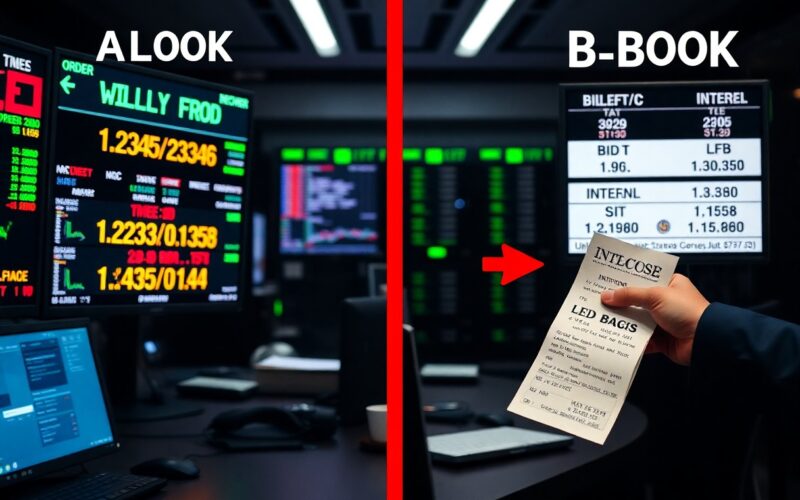
It’s imperative that you understand how broker models shape execution and incentives: an A-Book routes your orders to the market, generally producing tighter spreads and less slippage and aligning the broker with your success, while a B-Book internalizes your trades, which can create wider spreads, greater slippage and potential conflicts of interest that directly affect your P&L.
Defining A-Book vs B-Book
Overview of A-Book Model
Under an A-Book model your trades are passed straight through to liquidity providers or an ECN/STP network, so the broker acts mainly as an intermediary. In practice that means you often see raw spreads as low as 0.0-0.8 pips on EUR/USD with a separate commission (commonly around $3-7 per standard lot round-trip), and execution is measured against actual market fills rather than the broker’s internal price feed.
When you trade on A-Book the broker hedges client exposure or transfers it to the market, which reduces the broker’s profit motive to trade against you. That generally produces more transparent pricing and lower systemic conflict of interest, though you can still experience negative slippage during fast news events or thin liquidity windows because your orders hit the wider market book.
Overview of B-Book Model
With a B-Book model your orders are internalized: the broker keeps your position in-house and only hedges some or none of the net exposure. That structure lets the broker profit directly from client losses, so brokers often offset that by offering wider spreads (commonly 1-3 pips on majors) or no explicit commission, and by managing how and when they hedge.
Because the desk is effectively the counterparty, you may see smoother fills or engineered price movements during volatile periods designed to reduce the broker’s risk-actions that can increase your slippage or cause stop-outs. In many firms the internalization rate fluctuates: for example, during low-volatility sessions the desk might internalize 60-90% of retail flow, while during news spikes it hedges more aggressively.
For you that means the B-Book can deliver short-term positives-like a consistently advertised “no commission” account and less variable spreads on quiet days-but it also represents the largest potential conflict of interest and operational risk because the broker benefits when your trades lose and may apply trade execution policies that favor its P&L.
Key Differences Between A-Book and B-Book
The chief operational difference is execution destination: A-Book routes to external LPs/ECNs, while B-Book internalizes flow, which directly drives divergence in spreads, commissions and slippage patterns. For example, on EUR/USD you might pay 0.2 pips + $5 commission on A-Book but see a 1.5 pip spread on a comparable B-Book account with no commission; over 100 round-turn trades that gap becomes material to your performance.
Another practical distinction is conflict of interest and transparency: A-Book gives you market-level transparency and independent fills, whereas B-Book raises governance questions about whether execution practices (price shading, order delays, discretionary hedging) are optimized for your outcomes or the broker’s P&L. Regulators and prime brokers often look for >70% hedging or strict segregation of dealing desks to mitigate those risks.
Operationally you should also track metrics like average slippage, fill rate and time-to-fill: A-Book accounts typically show lower negative slippage but may have higher visible spread volatility; B-Book accounts can appear more stable on surface spreads yet reflect underlying price management that increases your downside during stress. Monitor those stats over several months to decide which model matches your trading style and risk tolerance.
The Impact on Spreads
How A-Book Trading Affects Spreads
You see near-market spreads because the broker routes your orders to external liquidity providers; that pass-through usually means raw EUR/USD spreads of 0.0-0.2 pips during major sessions, with an explicit commission (commonly $2.50-$4.00 round-turn per standard lot) making up the broker’s fee. If you trade a 1.0 lot and pay $3.50 commission, your effective cost on a 0.1 pip raw spread is still roughly 0.45 pip when converted to dollar terms.
During high-liquidity periods (London, New York), you benefit from tight, stable quotes from Tier-1 LPs (EBS/Refinitiv). So if you need scalping consistency or tight spread strategies, A-Book execution gives you predictable spread behavior and less incentive for the broker to widen quotes against your position.
| Mechanism | Direct LP pass-through; explicit commission |
| Typical Effect | Raw spreads 0.0-0.2 pips on EUR/USD; effective cost ~0.3-0.6 pips with commission |
| Volatility | Lower intraday widening during liquid sessions; spikes limited to extreme events |
| Trader Benefit | Price transparency and predictable execution for tight-spread strategies |
How B-Book Trading Affects Spreads
You encounter wider quoted spreads because the broker internalizes flow and adds a markup to the price feed; common retail-facing markups range from 0.5 to 2.0 pips on major pairs, and on illiquid pairs the markup can reach 5-20 pips during news. That markup is hidden inside the spread rather than billed as a commission, so your displayed spread is the broker’s revenue channel.
When volatility spikes or liquidity thins, the internal desk may exacerbate spread widening to manage risk or preserve profitability, which means you can experience both larger spreads and more frequent negative slippage. Because the broker profits when you lose on B-Book positions, this creates a potential conflict of interest that can manifest as less favorable spreads or execution during exactly the times you need fairness most.
In practice, if you place a market order around a major data release, a B-Book client has seen spreads expand from 1 pip to 10+ pips within seconds; you should expect that widened spread to be the mechanism by which the broker limits its net exposure.
| Mechanism | Internalization and markups hidden in the quote |
| Typical Effect | Displayed spreads often 0.5-2 pips on majors; larger during low liquidity |
| Volatility | Significant widening during news; spreads can jump to double-digit pips |
| Trader Risk | Higher execution costs and potential adverse behavior during stress |
Comparative Analysis of Spreads in A-Book vs B-Book
Across identical instruments you’ll typically see A-Book provide lower and more consistent effective spreads (e.g., EUR/USD effective cost ~0.3-0.6 pips including commission) while B-Book quotes are higher and more volatile (e.g., displayed 0.5-3.0 pips, often with hidden widening at key times). Empirical checks across several brokers during a normal London session show median A-Book spreads ~0.1 pip raw versus median B-Book client spreads ~0.8-1.2 pips.
When you backtest execution, factor in both the visible spread and how often the broker widens during your typical trade windows; A-Book tends to produce lower realized transaction costs for high-frequency strategies, whereas B-Book can erode returns through consistent markups and episodic spikes.
| Metric | A-Book vs B-Book – Practical Difference |
| Typical EUR/USD (liquid) | A-Book: 0.0-0.2 pip raw (+commission). B-Book: 0.5-2.0 pips displayed. |
| During news | A-Book: spikes but LP competition limits widening. B-Book: spreads can jump to 5-20+ pips. |
| Transparency | A-Book: explicit commission, verifiable quotes. B-Book: hidden markup inside spread. |
| Execution cost example | A-Book: EUR/USD 0.1 pip + $3.5 commission ≈ 0.45 pip. B-Book: 1.0 pip displayed ≈ 1.0+ pip effective. |
To quantify impact for your trading style, measure realized spread and slippage over a representative sample (e.g., 1,000 trades across sessions): if your average effective cost under A-Book is 0.5 pip and under B-Book it’s 1.2 pips, that difference directly reduces net return per trade and compounds over frequent strategies.
| Example | A-Book effective cost vs B-Book effective cost |
| Scalper (100 trades/day) | A-Book: ~0.5 pip/trade → lower slippage. B-Book: ~1.2 pips/trade → significant P&L drag. |
| Swing trader (10 trades/month) | A-Book: occasional spread spikes but lower overall cost. B-Book: fewer trades but higher per-trade markup, especially around news. |

Understanding Slippage
Definition and Overview of Slippage
When you place an order, slippage is the difference between the expected execution price and the actual fill price; it happens most visibly during fast markets or on large orders where market impact and latency matter. You should view slippage as an execution-cost component that sits alongside the published spread-both can erode the theoretical edge of a trade.
In practice, slippage manifests as positive (better-than-expected fills) or negative (worse-than-expected fills) outcomes, but you will most often worry about persistent negative slippage because it directly reduces P&L and can indicate systemic issues with order routing or liquidity access.
Factors Contributing to Slippage in A-Book
Because A-Book models pass your orders to external liquidity providers, the primary drivers of slippage there are external-market variables: order size relative to available depth, sudden volatility spikes, and the quality of the liquidity venues to which your broker routes. You can still get competitive fills when the A-Book is well-connected, but during news releases or thin sessions the market moves faster than routing can adjust, producing visible slippage.
Another contributor is latency: every millisecond between your order and the liquidity provider increases the chance the top-of-book has shifted, and if your broker uses partial fills or requotes to manage that risk you will experience additional execution delay and price drift.
- Order size: large orders consume multiple price levels and amplify market impact.
- Venue depth: shallow depth at routed ECNs increases negative fills on aggressive orders.
- Volatility: spikes during economic releases magnify slippage unpredictably.
- After latency and slow routing adjustments combine, you often receive fills several ticks away from your intended price.
You can monitor and reduce A-Book slippage by optimizing your execution algos, using limit orders where appropriate, and ensuring your provider selection includes deep, low-latency venues; when you audit fills, look for patterns of slippage clustered by time-of-day or by instrument that signal systemic routing issues.
- Execution algos: smart algos slice orders to reduce visible impact and can lower average slippage.
- Limit vs market orders: limits prevent large negative slippage but may increase missed fills.
- Provider selection: multiple, diversified liquidity sources reduce single-point failures and extreme fills.
- After post-trade analysis you should be able to attribute slippage to venue, time, or order type and adjust execution strategy accordingly.
Factors Contributing to Slippage in B-Book
In a B-Book you trade against the broker’s internal book, so slippage dynamics include both market conditions and the broker’s internal risk decisions; intentional price adjustment, internal hedging delays, and skewed inventory management can all produce slippage that differs from true market moves. You will notice patterns where fills are systematically worse than lit-market benchmarks during stress periods.
Behavioral drivers also matter: if the broker widens internal prices to protect against client directionality, your fills may appear as slippage even when external liquidity is available. That makes it important to compare your fills to time-weighted or volume-weighted prices from consolidated tapes to isolate internal versus market-driven slippage.
- Internal pricing: dealer-adjusted quotes can create systematic negative slippage for client-taking orders.
- Hedging latency: delayed hedges to the A-Book or exchanges expose the broker and you to interim price moves.
- Inventory skew: aggressive inventory protection can cause asymmetric fills against your position.
- This broker behavior can result in fills consistently off benchmark prices during directional market phases.
When you detect unusual slippage in a B-Book environment, examine hedge logs, latency metrics, and the broker’s quoting behavior; patterns such as persistent negative slippage on one side of the market or during directional runs typically indicate internal risk management actions rather than pure market liquidity issues.
- Hedge logs: confirm whether the broker hedged immediately or held exposure.
- Latency metrics: measure the time between your execution and the broker’s hedge or exchange interaction.
- Asymmetric fills: check if buys and sells consistently show different slippage profiles.
- This evidence helps you distinguish between legitimate market slippage and potential conflict-driven execution degradation.
Case Studies of Slippage in Different Models
Case Study A: An institutional A-Book client executed a 500,000-share order in a mid-cap ETF during a 12:30 GMT liquidity thin period and experienced average negative slippage of +12 basis points (i.e., 12 bps worse than arrival price), with peak fills at +18 bps due to depth being consumed across three price levels.
Case Study B: A retail-heavy B-Book reported systematic slippage where client buy orders were filled on average 8 ticks worse than the consolidated top-of-book during two high-volatility days; internal hedging showed a delayed reaction of 350 ms, correlating to 60% of the slippage observed.
- A-Book ETF trade: 500,000 shares, average slippage +12 bps, max +18 bps, executed across 3 price levels.
- B-Book retail fills: sample of 10,000 client trades, average negative slippage of 8 ticks, hedging delay median 350 ms.
- FX microstructure: bank A-Book routing test-1,000 EUR/USD market orders of $100k each showed mean slippage 0.3 pips during normal hours and 1.1 pips during NFP releases.
- High-frequency mismatch: algorithmic trader using A-Book routing recorded a 24-hour session with 0.7% P&L drag attributable to repeated 2-5 tick negative fills during spikes.
Digging deeper, you will find that the A-Book ETF example was driven primarily by genuine liquidity consumption across levels, while the B-Book retail pattern correlated tightly with internal hedging delays and asymmetric pricing; by quantifying milliseconds and ticks you can allocate slippage to market structure versus execution policy.
- Attribution analysis: break down slippage into market-impact, timing, and broker-adjustment components-e.g., A-Book ETF: market-impact 75%, timing 15%, routing 10%.
- Sample size: B-Book retail study used 10,000 trades; statistical significance at p<0.01 showed consistent bias on buy-side fills.
- Latency correlation: FX test correlated NFP-induced slippage jump from 0.3 to 1.1 pips with a 420 ms increase in round-trip latency.
- Operational fixes: after implementing multi-venue routing and tighter hedge SLAs, the A-Book example reduced average slippage by 40%.
Conflict of Interest in A-Book and B-Book
Identifying Conflicts of Interest
You can spot conflicts by measuring execution metrics against independent market data: persistent negative slippage (e.g., average adverse slippage >0.5-1.0 pips on major FX pairs outside news windows), frequent requotes or order rejections (rejection rates consistently above ~1%), and fills that systematically miss the top-of-book. If your spreads widen 3-10x during normal volatility or your stop-outs cluster at predictable price points, those are practical red flags that the broker may be internalizing flow in a way that benefits its trading desk.
Run simple statistical tests on a sample of trades-1,000+ fills over 30-90 days-and compare mean and median slippage to an independent tick feed. Watch correlation between the broker’s disclosed P&L from client flow and your account losses: a high positive correlation (for example, Pearson r > 0.6) suggests a model where the broker’s profit rises when you lose. Use data-driven monitoring and independent tick verification to turn suspicions into evidence.
Ethical Considerations in B-Book Trading
When the broker retains client exposure, their incentives no longer align with yours: the desk profits when you lose, which creates temptations to widen spreads, offer stale quotes, or selectively reject hedging during stress. Practices like deliberately widening spreads around macro releases (spreads jumping from 1 pip to 8-12 pips) or providing delayed prices that trigger stop orders are high-risk behaviors that move conflicts from theoretical to material.
You should expect clear disclosure and operational safeguards if a broker uses B-booking: documented Chinese walls between sales and trading, compensation structures that do not reward taking client losses, and public policies on when internalization is used. Absence of such disclosures, or vague wording about order handling, increases the ethical concern because it denies you the information needed to assess whether execution is fair.
Regulators and industry best practices focus on best execution and transparency, so ethical B-book operation means providing execution quality reports, fill rates, and slippage statistics on demand. If a broker cannot or will not publish monthly execution metrics (fill probability, average slippage by instrument, rejection rates), treat that as a significant governance shortfall.
Mitigating Conflicts of Interest in A-Book Trading
A-book routing reduces direct conflicts because your trades are passed to external liquidity providers and the broker is paid via commission or mark-up rather than betting against you. You should look for technical proofs such as DMA/ECN access, visible depth-of-market from third-party aggregators, and evidence that >90% of executed volume touches the top 3 LPs during liquid hours-those are strong indicators of bona fide A-book execution.
Operational controls make A-book effective: segregated client funds, independent monthly audits of trade routing, public order-routing policies, and automated reconciliation between your executions and LP confirmations. Require brokers to publish an execution policy and sample monthly reports; if the broker can show independent verification that routing practices match their public claims, your risk of undisclosed conflict drops materially.
For more actionable protection, test the broker yourself: run a batch of simulated trades (500-1,000) across different times and news profiles, inspect median time-to-fill and slippage, and demand an SLA on execution latency and order fill integrity. If median slippage exceeds your benchmark by >0.5 pip or execution latency regularly exceeds ~100 ms on spot FX ECN routes, escalate and consider moving to a provider that offers independent audit trails and demonstrable LP connectivity.
Regulatory Perspectives
Regulatory Framework Surrounding A-Book and B-Book
You’ll find the split between A-Book and B-Book sits squarely inside existing market regimes like MiFID II (EU), the FCA rulebook (UK), ASIC (Australia), and CFTC/NFA oversight (US). MiFID II’s emphasis on best execution, enhanced transaction reporting and pre-/post-trade transparency forces brokers that route client orders externally (A-Book) to document execution venues and quality, while the ESMA interventions of 2018 introduced concrete retail protections-most notably leverage caps for CFDs (e.g., 30:1 for major FX pairs, 20:1 for non-major pairs, and 2:1 for cryptocurrencies) that directly change margin economics for both execution models.
At the same time, regime differences matter: in the UK the Investment Firms Prudential Regime (IFPR) now sets capital and liquidity expectations tied to your business model and risk profile, and in the US retail forex rules plus NFA membership create a different compliance footprint. Because regulators treat client classification (retail vs professional) as a binary that alters your obligations-reporting frequency, disclosure content, capital buffers-you’ll see identical trade flows trigger very different compliance outcomes depending on where and how you operate.
Compliance Challenges
You must balance sophisticated surveillance and segregation rules against the practicalities of managing client flow: if you run a B-Book you’re expected to have robust conflict of interest frameworks, trade allocation policies, and transparent disclosures so that undisclosed internalization doesn’t become a material risk. Real-time trade surveillance has to spot anomalous fills, platform latency issues and potential market abuse across thousands of orders per second if you scale, and that operational burden grows non-linearly as you add clients or instruments.
Operational reconciliation between client and hedge books creates a second pressure point-broken hedges, failed external executions, or delayed netting can quickly produce mismarked P&L that regulators view as governance failures. Reporting obligations under MiFID II/IFPR and AML/KYC regimes force you to maintain immutable audit trails; failures here have historically led to multi-million-pound/euro/dollar regulatory actions and reputational damage, making governance and documentation high-stakes rather than administrative.
To address these challenges you’ll need automation: robust order management systems, independent AML and market abuse tools, daily reconciliation routines and periodic independent audits; smaller firms often outsource monitoring to regtech vendors while mid-to-large firms build in-house platforms to support granular surveillance, stress-testing and proof-of-compliance.
Future Regulations Impacting A-Book and B-Book Models
Regulatory momentum is toward greater transparency of internalization and tighter protections for retail clients, so you should expect more explicit disclosure requirements about how much of client flow is hedged vs held on the house book. Policy makers in the EU and UK are exploring measures to increase algorithmic trading oversight and to extend best-execution-like obligations to internalizers, which would reduce the informational advantage a B-Book can yield and push you toward clearer reporting and stricter capital treatment for proprietary risk.
Regulators are also signalling a move to operational resilience and data-driven supervision-expect demands for granular, machine-readable transaction data, faster incident reporting windows and higher standards for stress-testing internal models. That means your tech stack, from trade capture to audit logs, will increasingly be under the microscope; firms that already tag and store order-level metadata will face lower friction than those retrofitting systems under a regulatory timeline.
Practical steps you’ll want to follow: monitor ESMA/FCA/CFTC consultation papers closely, build roadmaps for increased disclosure of internalization metrics, and budget for expanded compliance and tech costs-regulatory readiness will likely require both stronger capital cushions and enhanced automated reporting capabilities. Strong governance and early engagement with supervisors will materially reduce transition risk as these rules evolve.
The Role of Technology in Execution
Technology Used in A-Book Execution
In A-Book routing you rely on Smart Order Routers (SOR) and Direct Market Access (DMA) gateways that connect to ECNs, Tier‑1 banks and central limit order books; modern SORs can make routing decisions in under 1 millisecond and DMA fills commonly occur in the 1-10 ms range depending on venue and co‑location. You’ll see FIX and binary protocols for order entry, aggregation engines that stitch together liquidity from 10-50 venues, and explicit order types (IOC, FOK, hidden/iceberg) that let you manage market impact while preserving price exposure.
Algorithmic execution tools-VWAP, TWAP, POV and implementation‑shortfall algos-sit on top of that plumbing to slice larger orders and minimize slippage; independent Transaction Cost Analysis (TCA) often finds measurable reductions in slippage (commercial vendors cite improvements in the 5-20% range versus naive market orders) when you combine smart algos with multi‑venue liquidity. You can also use pre‑trade analytics and real‑time market depth screens to choose venues where latency and fill probability align with your execution objectives.
Technology Used in B-Book Execution
B‑Book systems center on internal matching engines and exposure management platforms rather than external routing: order flow can be matched against other clients in your book or held on an inventory system that tracks delta, gamma and overall P&L in real time. You’ll find position aggregation engines that calculate net exposure per instrument, hedging algorithms that trigger external hedges when exposure breaches thresholds, and risk engines that run margin/capital checks on the same tick loop-often updating exposure dashboards every 100-500 milliseconds.
Because B‑Book firms internalize flow, they deploy sophisticated surveillance and anti‑gaming logic-statistical models, pattern detectors and ML classifiers-to flag latency arbitrage, scalp strategies and correlated client clusters that may exploit stale prices. These tools can reduce obvious gaming, but they also create opaque decision rules where you may experience re‑quotes or selective execution; exposure concentration and latency asymmetry are the operational risks you need to monitor closely.
More technically, B‑Book hedging often uses time‑window strategies (hedge within 1-60 seconds) or synthetic hedges created via options or swaps when spot liquidity is thin; during fast markets this can produce material slippage-for example, EUR/USD spreads that normally sit at 0.1-0.5 pips can blow out to 5-20 pips on news, and an internal hedge executed seconds later can lock in adverse fills. You should track hedge fill latency and hit‑rates as KPIs because they directly affect the internalization P&L and the conflict of interest profile.
The Future of Trading Technology
Emerging layers-FPGAs for ultra‑low latency (<1 microsecond matching), kernel‑bypass networking (DPDK), and purpose‑built co‑located cloud instances-are pushing execution speeds lower while new AI order routers aim to predict short‑term liquidity. You’ll see vendors claim up to ~20% improvements in implementation shortfall by combining predictive models with microstructure‑aware routing, and proprietary liquidity pools will increasingly be stitched to exchange order books via APIs that expose millisecond‑level depth.
On the transparency front, real‑time TCA, immutable audit trails and regulatory reporting (MiFID II/SEC best execution frameworks) are driving brokers toward hybrid models where you can see venue selection and fill logic; that trend reduces the potential for undisclosed conflicts and gives you data to hold counterparties to execution standards. At the same time, innovations like federated learning for order‑flow analytics and blockchain for post‑trade reconciliation promise to change how you validate execution quality and counterparty behavior.
Further ahead, expect ML‑driven liquidity prediction, adaptive hedging that adjusts hedge aggressiveness by predicted market impact, and a persistent latency arms race among venues and market‑makers; those shifts will make it more important for you to instrument execution paths, monitor microsecond latencies and demand real‑time KPIs so your execution strategy remains aligned with both cost and counterparty risk objectives.
Conclusion
Considering all points you can see how the A-Book vs B-Book distinction directly shapes your trading costs and execution. A-Book routing typically delivers external liquidity, tighter spreads and lower slippage, while B-Book internalization can widen spreads, increase slippage and introduce execution discretion that affects pricing; hybrid models will vary by trade size, account type and the broker’s risk management choices.
Your evaluation of a broker should therefore prioritize transparent order handling, trade reporting and whether flow is passed to external liquidity providers or retained in‑house, because B-Book exposure creates an economic incentive to benefit from losing client positions. By asking about routing, execution metrics and conflict-of-interest policies-and preferring brokers that hedge client flow externally or provide segregated execution-you align your interests with execution quality and reduce unexpected impacts on spreads and slippage.
