

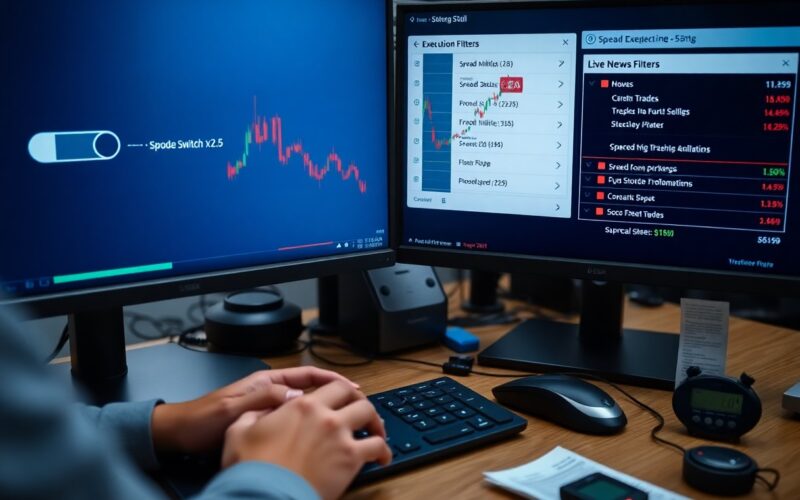
Just be aware that during major news events your trading environment can change dramatically: brokers may enact mode switches, apply spread multipliers causing widened spreads, or enable execution filters that produce delayed or rejected orders; at the same time some firms offer liquidity protections or guaranteed-stop options that limit catastrophe-level losses, so you must check pre-release policies, adjust order size, and use limits to manage risk.
Understanding Trading Conditions During News Events
The Impact of News on Financial Markets
When a high-impact release hits the tape, you will often see immediate, large swings as liquidity providers pull quotes and algorithmic traders reprice risk; for example, US Nonfarm Payrolls (NFP) surprises frequently produce initial moves of 100-200 pips in FX majors and intraday equity gaps of several percent. Central bank rate decisions and surprise CPI prints similarly move bond yields-an unexpected 0.3% monthly CPI surprise can push the 10‑year US Treasury yield by 10-25 basis points, which then ripples into FX, equities and commodity markets within seconds.
Cross-market contagion is common: you might see an FX pair move first, then equities gap, then yields adjust as market makers rebalance delta and duration exposure. Historical events show the scale: the 2015 SNB unpegging produced multi‑hundred‑pip moves in EUR/CHF in minutes, while the 2010 Flash Crash erased and then partially restored >9% in US equity indices in under an hour-both examples of how liquidity evaporation and fast repricing amplify news impact.
Key Economic Indicators and Their Effects
NFP, CPI, unemployment rate, GDP and central bank statements are the headlines that move markets most; NFP and interest‑rate decisions sit at the top for FX and bond traders, CPI and core‑CPI drive real yield repricing, and PMI/retail sales reveal cyclical momentum. You should watch consensus vs. actual: an NFP beat of +250k versus an expected +170k typically strengthens the USD and can lift yields by several basis points within minutes, while a large downside surprise often triggers immediate stop cascades in leveraged FX positions.
PMI prints around the 50.0 threshold act as a sentiment switch-moves from 49.0 to 51.0 can flip risk‑on flows into equities and commodities, and you’ll see correlated FX moves (e.g., AUD and NZD). Tradeable detail matters: markets react more to core measures and revisions than to headline numbers; a revised GDP upward is often more market‑moving than a small initial surprise because it changes the outlook for policy.
Timing and nuance also matter to your execution: NFP is released at 8:30 ET (13:30 GMT) with an initial market knee‑jerk that often reverses within 15-45 minutes as high‑frequency strategies unwind-so if you trade the release, expect a two‑phase move (fast spike, then digest) and size your orders accordingly to avoid outsized slippage.
Market Volatility and Spreads During News Releases
Spreads and volatility expand dramatically at high‑impact events; a typical ECN EUR/USD spread of 0.1-0.5 pips can blow out to several pips, and on some market‑maker platforms widen to tens of pips during the first 30-60 seconds of a major release. Execution behavior changes too: you may see orders rejected, fills at distant price levels, or execution filters invoked by your broker’s “news mode” that convert your market orders into re‑quotes or impose minimum fill sizes.
Volatility metrics spike accordingly: intraday ATRs can increase 3-10x on NFP/CPI days, and implied volatility in options markets re‑prices within minutes. For example, EUR/USD 1‑hour realized volatility routinely jumps from ~0.05% to >0.5% around NFP, meaning your stop distances and position sizing should be scaled up if you remain in the market during the print.
Order type behavior during these windows is important for you: market orders face the worst slippage, limit orders may never execute, and stops can be executed far from the displayed quote due to liquidity gaps-so consider smaller size, wider stops, or stepping out of market exposure entirely until spreads re‑normalise.
Broker ‘Mode Switches’
Definition and Importance of Mode Switching
Mode switching refers to the practice where a broker changes the way it prices, routes or executes trades during periods of elevated volatility or thin liquidity; you’ll see this when a broker moves from normal STP/ECN routing to a principal/market‑making stance, applies a spread multiplier, or temporarily disables order types. In events like the 2015 EUR/CHF shock (≈30% intraday move) many firms flipped modes to protect back‑end risk systems and customer accounts from extreme slippage and forced liquidation cascades.
When you trade through a broker that can switch modes, you need to expect altered execution quality: spreads can widen by multiples (often 5-50×), margin requirements may jump to 100-500% of normal, and fills can be re‑priced or delayed. The
How Brokers Manage Risk During High-Impact Events
Brokers apply a mix of operational and automated controls: immediate actions include spread widening, raising margin rates, restricting new positions or hedging, and imposing max‑slippage or execution filters; backend measures include throttling order flow to liquidity providers and switching to internal liquidity pools. For example, during major US NFP prints you’ll commonly see EUR/USD spreads move from sub‑1 pip to 5-30 pips and some brokers suspend stop entry orders to avoid automatic fills at off‑market prices.
You should note that some brokers will also flip execution model – effectively taking risk onto their books – which reduces latency risk but can expose you to internal pricing adjustments or requotes. Firms with smaller liquidity aggregation may lean more heavily on order restrictions and temporary market suspensions to avoid operational losses.
The way those rules activate is typically rule‑based (e.g., a price gap threshold or liquidity provider quote pull), and brokers will document triggers in their terms of business and newsfeed notifications.
- Spread widening – automatic multipliers applied to quoted spreads
- Margin increases – temporary higher margin requirements to reduce position size
- Order type restrictions – disabling stops, limit entries or hedging
- Execution model switch – routing from ECN/STP to market‑maker/principal
- Trading halt – temporary suspension of new orders or entire symbols
Types of Mode Switches Used by Brokers
Brokers generally deploy a small set of repeatable mode switches you’ll encounter: spread multipliers (widened spreads), execution model switches (routing changes), order restrictions (disabling stops or limiting new trades), trading halts, and slippage/execution filters that reject or reprice fills beyond thresholds. Each type has a predictable impact on your P&L – for example, a 10× spread multiplier on a typical 1 pip EUR/JPY spread turns execution cost into ~10 pips instantly.
Operationally, triggers are usually set by observable metrics: quote depth dwindling below a threshold, a liquidity provider pulling quotes, or a predefined price move (e.g., X% move in Y minutes). In practice, you’ll see margin calls earlier and more frequent partial fills when these switches engage, especially on thinly traded crosses and small‑cap CFDs.
| Mode | Description / Typical Trigger & Impact |
| Spread multiplier | Multiples applied to normal spreads when liquidity thins; impact = execution cost ↑ (5-50× typical) |
| Execution model switch | Routing from ECN/STP to market maker when external liquidity is unavailable; impact = internal pricing, potential requotes |
| Order restrictions | Disable stop entries, limit order acceptances or hedging; trigger = extreme volatility or quote feed errors; impact = fewer fills, protective measures |
| Trading halt / symbol suspension | Temporary close of a market or symbol when fair pricing cannot be provided; trigger = provider outage or regulatory pause; impact = no new trades |
| Slippage/execution filters | Max slippage thresholds that cap or reject fills beyond X pips (often 10-50 pips); impact = rejected orders or post trade adjustments |
The
- Spread multipliers
- Execution model switches
- Order restrictions
- Trading halts
- Slippage filters
Spread Multipliers
What Are Spread Multipliers?
Spread multipliers are vendor-side rules that multiply the quoted spread during specified conditions – typically high volatility, major news, or after-hours sessions. You will see multipliers expressed as 1x, 2x, 5x, etc.; for example a base EUR/USD raw spread of 0.5 pip with a 5x multiplier becomes 2.5 pips, and some brokers have been observed applying multipliers that push spreads into double-digit pips on thin markets.
They are applied per-instrument and often tied to a broker’s internal “risk window” or an automated volatility detector. In practice this means a single economic release (NFP, ECB rate decisions) can flip EUR/USD from a typical 0.2-0.8 pip environment to a 3-10 pip environment within seconds, directly altering the cost of every trade you place during that window.
How Spread Multipliers Affect Trading Costs
Multipliers increase your entry and exit costs immediately: with larger spreads your break-even threshold widens. For instance, a scalper targeting 2 pips profit on EUR/USD with an expected 0.5 pip spread can be rendered unprofitable if the spread is multiplied to 3 pips – your effective cost rises from 0.5 to 3 pips, turning a 2-pip target into a losing trade before slippage is considered.
They also amplify realized slippage and skew backtest performance if you don’t model them. If you backtest assuming mean spread = 1 pip but your broker applies 4x multipliers during 10% of sessions, your historical edge may evaporate; that 10% of sessions can account for a disproportionate share of drawdown and trade failures.
Execution quality is affected too: your market orders are filled at worse prices when spreads blow out, which increases the chance of stop-outs and forces you to widen stops or reduce position size – both of which change your risk/return profile in measurable ways.
Best Practices for Trading with Spread Multipliers
Set automated spread thresholds and integrate them into your trade logic: for example, disable scalping or market entries if spread > 3x normal or if EUR/USD > 2 pips for accounts that usually see <0.5 pip spreads. You should also check your broker's policy for multipliers (how they're triggered, max multiplier, instrument scope) and map those rules onto your economic calendar so you can preemptively pause or alter strategies around known events.
Use limit orders where feasible, model multipliers in backtests (run scenarios at 3x, 5x, 10x), and size positions conservatively during high-risk windows – a simple approach is to divide normal lot size by the multiplier (if spread is 5x, trade 1/5th size). Doing so protects your stated edge and prevents hidden cost leaks from wrecking short-term strategies.
Finally, maintain a short checklist before entering trades around news: confirm current spread, check multiplier history for the instrument, and switch off or throttle EAs if the spread exceeds your predefined limit – this operational discipline is the easiest way to convert multiplier-awareness into fewer unexpected losses.
Execution Filters
Definition and Functionality of Execution Filters
Execution filters are broker-side rules that decide whether your order is filled, delayed, or rejected when market conditions change rapidly. They typically operate as a combination of a price collar (max deviation), a time hold (latency window), and a volume check, applying thresholds such as 1-5 pips for FX or 100-500 ms for holds; this means your market order can be blocked or re-quoted if the market moves beyond those limits. You should expect that filters reduce adverse fills during extreme volatility but also increase the likelihood of rejected orders and missed opportunities when price moves through your level quickly.
Under news spikes, filters frequently interact with other protections like spread multipliers and execution caps, so the net effect on your trade execution depends on stacked rules rather than a single setting. For example, a max-deviation of 2 pips combined with a 300 ms hold can convert a market entry into a delayed fill or a rejection on EUR/USD during an initial 20-40 pip move after a major data release; that trade behavior is what you encounter when brokers prioritize order integrity over fill immediacy.
Types of Execution Filters and Their Applications
There are five common filter types you will see: max deviation/price collars that cap acceptable slippage, latency/time holds that queue orders for a brief window, volume/size filters that block orders exceeding available liquidity, fair-price checks that reference external liquidity, and spread/slippage caps that reject fills beyond a set spread or slippage percentage. Each type is applied depending on the broker’s risk tolerance and the instrument: scalpers face tighter price-collar thresholds, while institutional flow is more likely to hit volume gates.
- Max deviation / Price collar – prevents fills outside a set pip limit.
- Latency / Time hold – holds execution 100-500 ms to await price confirmation.
- Volume / Size filter – rejects orders larger than on-book liquidity.
- Fair-price / Price check – cross-checks with external feeds before filling.
- Knowing spread/slippage caps cause frequent rejections during news spikes.
| Filter Type | Typical Setting & Effect |
| Max Deviation / Price Collar | 1-5 pips (FX) – blocks or re-quotes when price moves beyond the collar |
| Latency / Time Hold | 100-500 ms – delays fills; reduces negative fills but increases misses |
| Volume / Size Filter | Depends on depth – orders > available liquidity are rejected or partially filled |
| Fair-Price Check | External feed comparison – avoids fills against stale internal prices |
| Spread / Slippage Cap | Fixed pip or % cap – rejects fills when spreads spike (e.g., +50-200% during news) |
Application-wise, you should align filter tolerance with your strategy: if you scalp for 0.5-2 pips, a price collar >1 pip and a hold <200 ms are vital to preserve fills; by contrast, swing traders can accept larger collars and longer holds because execution immediacy is less important. Empirical testing against past high-volatility events-like NFP windows where EUR/USD can move 30-50 pips in the first minute-lets you quantify how many fills a given filter configuration will reject or delay.
The Role of Execution Filters in Slippage Prevention
Execution filters act as a first line of defense against negative slippage by refusing fills that exceed predefined deviation or spread limits, so your worst-case slippage is bounded rather than unbounded during flash moves. In practice, that means during a 20-40 pip burst you might see zero fills (rejections) instead of fills 10-30 pips away from your order; the trade-off is that you lose execution certainty in exchange for protection from large adverse fills.
On the flip side, filters can create artificial slippage in the form of missed execution and re-quote latency, which matters if you rely on tight stop-loss or take-profit levels. For instance, a 3-pip max deviation will prevent a 10-pip adverse fill but will also reject many entries for scalpers during news, effectively shifting your operational risk from price execution to non-execution risk.
When you design your risk controls, test filters under historical news scenarios and request a broker’s documented thresholds and fill/rejection statistics; that lets you measure how filters change realized slippage distributions and decide whether the protection is worth the increased rate of missed trades.
Trader Strategies During News Events
Position Sizing and Risk Management
You should cut position size significantly when trading high-impact releases – from a typical risk of 1% of equity down to 0.25-0.5% per trade during events like US NFP or CPI. For example, on a $100,000 account a 0.25% risk equals $250; with a widened stop from 20 to 60 pips you must reduce lots accordingly to keep that dollar risk. Factor in that many brokers apply spread multipliers of 3x-10x during the first minute after a headline, so include expected spread cost in your position-sizing calc rather than assuming pre-news spreads.
You should prefer smaller, staggered entries (scaling in) or using a single reduced-size order and then add only if price behaves predictably. Where available, use guaranteed stop-loss orders for a fixed cost if you need absolute stop protection; otherwise plan for potential slippage – historical data shows slippage of 10-100+ ms can translate into several pips at volatile times, so treat stop placement and max loss limits as your primary defense.
Timing Entries and Exits
Avoid placing market orders at the instant of release; instead wait for the initial volatility impulse to resolve – typically 30 seconds to 3 minutes after the print. You can use a simple rule: wait for two consecutive 1-minute candle closes beyond the pre-news range or for price to retest the breakout level before entering. For breakout trades, confirm direction with higher-timeframe bias (15m/1h) so you’re trading with structure rather than raw noise.
Exit plans should be tied to dynamically measured volatility. Use ATR or Bollinger width on the timeframe you trade: if 5-minute ATR jumps from 10 to 25 pips during a release, set initial profit targets to 1-2× the new ATR and implement a trailing stop at 0.5× ATR to lock gains as the move extends. If you see spread multipliers or execution delays, tighten profit targets and consider smaller targets to avoid execution decay.
One practical timing rule: on EURUSD NFP runs, many traders wait for a 3-minute consolidation after the initial 1-2 minute spike and then enter on a pullback to the spike high (for breakout) or to the spike low (for reversal) with a stop beyond the opposite spike extreme; this method reduced false entries in backtests where the first impulsive 60-pip move retraced 30-50% within five minutes.
Using Technical Analysis in Conjunction with News
You should use technical levels as bias filters, not as precise entry machines during news. Identify daily/4H support and resistance, VWAP, and liquidity zones pre-release so you can see whether the print is hitting a structural level – if the headline aligns with the 4H trend and price breaks the pre-news range above VWAP, you can justify slightly larger exposure; if it breaks against trend, reduce size or stay out.
Combine volatility metrics (ATR, Bollinger bands) with price action: if bands widen sharply and volume/tick activity spikes while price fails to close beyond a level twice, treat that as a high-probability failure and trade the retest instead of the initial breakout. Be aware that many lagging indicators produce false signals in the first 1-5 minutes; rely on price structure and confirmed retests rather than indicator crossovers during the spike.
For an actionable setup, mark the pre-news high/low and VWAP. After the release, if price breaks the pre-news high, waits for a retest to VWAP or the high within 1-3 minutes, and spread remains below 3× normal, then enter with a stop just under the retest and a target at 1.5× the immediate post-retest ATR – this blends technical confirmation with volatility-aware sizing and helps filter out directional whipsaws.
Broker Comparisons and Choosing the Right Partner
| Evaluating Brokers Based on News Event Performance |
Evaluating Brokers Based on News Event PerformanceYou should measure brokers by concrete metrics during high-impact releases: typical spread multipliers (how many times the normal spread is applied), slippage distribution (median and 95th-percentile slippage on market orders), order-fill rates, and incidence of execution freezes or rejects. For example, a broker that routinely multiplies spreads by 2-5× on hourly data is materially different from one that spikes to 10× or more during the first 30 seconds of an NFP print; that tail behavior is where most P&L damage happens. Run backtests and live micro-tests across at least a year of high-impact events (e.g., 12 monthly NFPs, ECB rates, FOMC). You should collect timestamped fills and measure latency (baseline 50-200 ms vs. event spikes of 200-1,000 ms), plus record partial fills and re-quote frequency. Brokers that provide downloadable execution reports or a FIX feed make this analysis straightforward; otherwise you’ll have to request tick-level reconciliation or use a colocated VPS for consistent measurements. |
| Importance of Broker Reputation and Trustworthiness |
Importance of Broker Reputation and TrustworthinessYou should prioritise brokers with clear regulatory oversight and operational transparency because regulatory status (FCA, ASIC, NFA/CFTC, or equivalent) materially reduces counterparty risk. Check whether the broker segregates client funds, publishes audited financials, and offers protections like negative-balance protection; these are indicators that your capital is treated according to industry standards rather than being at the mercy of opaque house rules. Operational history matters: outages, repeated execution complaints, or enforcement actions are red flags. When you evaluate reviews and forum posts, focus on documented cases with timestamps and ticket numbers rather than anecdotes. A broker with a history of short, isolated incidents plus prompt remediation is preferable to one with recurring outages during every liquidity squeeze. Dig into order-routing and business model disclosures: A-book (straight-through processing) vs. B-book (principal/market-making) determines conflict-of-interest potential during extreme moves. You should request a written description of their execution policy, and if they refuse or give vague answers that’s a significant warning sign. |
| Tools and Resources for Traders During News Releases |
Tools and Resources for Traders During News ReleasesYou need a toolkit that combines pre-release signals and post-trade analytics: a high-quality economic calendar (filterable by impact and currency), a low-latency news feed (Bloomberg/Reuters or reliable low-cost alternatives), and access to historical tick data to replay events. Use a VPS colocated near your broker’s execution servers if you place latency-sensitive trades; aim for round-trip latency under 20-40 ms to meaningfully reduce slippage on scalp strategies. Order types and API access are equally important: brokers that offer Guaranteed Stop Loss Orders (GSLOs), market-if-touched, or FIX/API execution let you automate defensive behaviour during spikes. Combine that with a tool to log fills and compute slippage histograms (median, 90th, 99th percentiles) across at least 100 fills so you can set realistic expectations for worst-case outcomes. Also subscribe to historical-tick providers like Dukascopy or your broker’s tick archive to run event-driven simulations; you should be able to reproduce at least a dozen past high-impact events to validate execution and risk controls before trading live. |
Final Words
From above you should understand that broker mode switches, spread multipliers and execution filters materially alter pricing and order handling around news: spreads can widen dramatically, executions can be delayed, re‑quoted or rejected, and slippage becomes more likely. You must trade knowing that liquidity and execution quality are variable during announcements and that your normal entry, stop and sizing assumptions may no longer hold.
You should adapt your plan accordingly-reduce position size, use limit or staggered entries, widen risk buffers, and test your broker’s live and demo behavior against historical news events. Keep strict risk controls, review the broker’s policy on volatility measures and execution filters, and accept that conservative trade management and prior testing are the most effective ways to preserve capital and consistency when news drives the market.
