

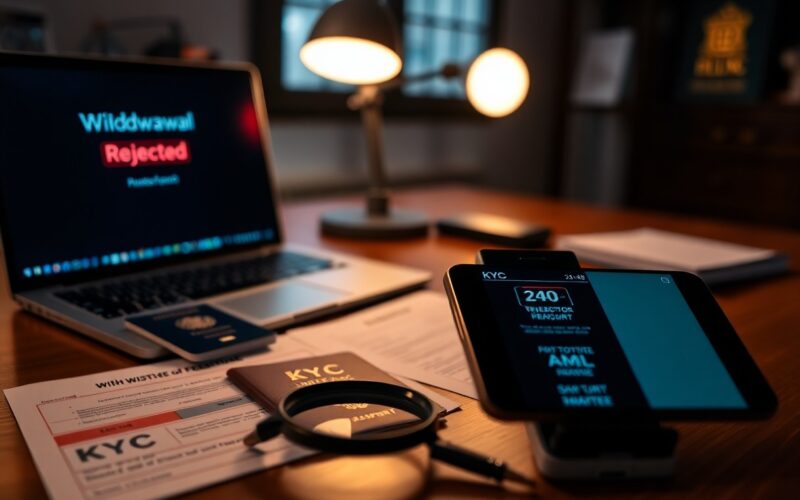
There’s a long list of KYC/AML triggers-mismatched ID, unexplained deposits, rapid trading, and opaque source-of-funds-that can make your broker freeze or reject withdrawals. To avoid delays, make sure you submit clear, matching ID and proof-of-address, documented source-of-funds, and use consistent payment methods, respond promptly to requests, and keep transaction records. Being proactive reduces the chance of holds and speeds up approvals.
Understanding Withdrawal Rejections
Common Reasons for Withdrawal Issues
Mismatched account details are one of the fastest ways to halt a withdrawal: if the beneficiary name, account number, or IBAN doesn’t match the name on your verified profile, brokers will often reject the request and ask for corrected documentation. Funding method inconsistencies also trigger delays-for example, if you deposited with a debit card but request a wire to a different person’s account, that frequently leads to a freeze while the broker verifies the source of funds.
Unusual activity patterns-such as rapid deposit/withdrawal cycles, large single transactions, or transfers to high-risk jurisdictions-commonly prompt manual AML reviews. Transactions over common reporting thresholds (for instance, $10,000 in many U.S. frameworks or similar €10,000-level thresholds in Europe) are automatically scrutinized, and missing proofs like bank statements or invoices can extend processing from 24-72 hours to several weeks. Incomplete responses to document requests are the most frequent cause of long delays and escalations to compliance.
Importance of KYC (Know Your Customer)
Your broker relies on KYC to verify identity and prevent fraud; failure to provide acceptable documents will block withdrawals. Typical requirements include a government-issued photo ID (passport or national ID), a recent utility bill or bank statement dated within the last 3 months as proof of address, and for larger or complex accounts, proof of source of funds-bank statements, payslips, or third-party sale agreements.
Verification timelines vary: automated checks can clear simple accounts within 24-72 hours, while complex profiles-corporate entities, multiple beneficiaries, or PEPs (politically exposed persons)-may require manual review that takes 5-10 business days or longer. If your name has changed, or documents are expired or low-resolution, that typically triggers a secondary request and pushes payouts into a hold status. Providing clear, dated, and certified documents up front reduces the chance your funds will be frozen.
For corporate accounts or when you’re the beneficial owner, expect additional KYC layers: company registration, list of shareholders and ultimate beneficial owners (UBOs), and proof of business activity. Many brokers enforce UBO disclosure where anyone holding >25% ownership must be identified; failing to disclose this can result in prolonged account suspension until ownership is fully documented.
Overview of AML (Anti-Money Laundering) Regulations
AML rules force brokers to monitor for laundering indicators and to file Suspicious Activity Reports (SARs) when patterns fit regulatory red flags-structuring deposits below reporting thresholds (smurfing), repeated rapid in-and-out trades, or transactions involving sanctioned or high-risk countries. Brokers also apply risk-based checks: higher-risk customers (based on geography, industry, or PEP status) face more frequent reviews and tighter limits.
When a SAR is filed, brokers are often legally barred from notifying you about the report and may keep your account frozen while regulators investigate; that process can take weeks to months depending on the case. To avoid triggering AML escalation, keep funding consistent, avoid third-party funding unless pre-approved, and disclose legitimate large incoming funds with supporting evidence (sale contracts, inheritance documentation, or corporate invoices). Failing to provide credible source-of-funds documentation is the most common reason for an AML-driven withdrawal rejection.
Specific preventive practices include: using the same withdrawal method as your deposit where possible, keeping transaction patterns steady, and pre-notifying your broker of incoming large transfers. Institutions typically rely on automated monitoring algorithms that flag deviations from your historical behavior-so maintaining clear, documented financial trails is the most direct way to minimize AML-related holds.

How to Ensure Smooth Withdrawals
Tips for Completing KYC Requirements
You must submit clear, recent documents: a government ID (passport or national ID), a bank statement dated within the last 90 days showing your account number and name, and a utility bill or official letter for address proof. Scan or photograph at 300 DPI in color, save as PDF, JPG or PNG, and keep individual files under 5 MB. Ensure the name on your ID exactly matches your bank account and broker profile, and if you expect a large withdrawal (for example, over $10,000) include source of funds documents upfront such as salary slips, sale contracts, or bank transfer records to avoid extended reviews.
- When asked for KYC selfies, hold your ID next to your face with a handwritten date and the broker name visible.
- Upload proof of the original deposit or transfer if you used a card or third-party – brokers flag third-party payments.
- Translate non-English documents with a certified translation and attach the translator’s contact info.
- Respond to compliance requests within 24-48 hours; many systems auto-escalate after missing deadlines.
Perceiving high-quality, consistent documentation and replying within 24-48 hours can cut hold times from days to hours with many brokers.
Understanding Broker Policies
You should know typical timelines and thresholds: many brokers complete standard KYC checks in 24-72 hours, but enhanced due diligence for large or unusual transactions can take 7-14 business days or longer. Policies commonly trigger reviews for withdrawals over $10,000, repeated rapid deposits/withdrawals, use of third-party payments, links to sanctioned jurisdictions, or if your name appears on screening databases (for example, World-Check). If you fund accounts with cards, expect card verification holds and possible requirement to refund card deposits before bank withdrawals are allowed.
For example, a retail trader who tried to withdraw $25,000 after receiving a family transfer faced a 12-business-day hold until they provided a signed affidavit plus the sender’s bank statements; once supplied, compliance released funds the same day. You should read your broker’s terms for stated processing windows, maximum same-day limits, and whether notarized documents are required for high-value requests, and always log ticket IDs when communicating with support to speed follow-up.
Factors Causing Delays in Withdrawals
- KYC / verification documentation mismatches
- AML screening and enhanced due diligence
- transaction limits and payment-method rules
- inactive accounts and dormancy reactivation
- Internal compliance backlogs or banking rails delays
Account Verification Issues
If your ID or proof-of-address documents don’t meet the broker’s specs, withdrawals are routinely placed on hold. Common triggers include an expired passport, a utility bill older than 90 days, low-resolution scans, or a name mismatch between your ID and bank account; these can extend processing from the usual 24-72 hours to 3-10 business days while compliance performs manual checks.
You can reduce those holds by submitting high-quality PDF/JPEG files under 5 MB, both sides of ID when requested, and a bank statement showing the account number and IBAN that matches your withdrawal destination. For example, a trader who uploaded a bank statement with a maiden name experienced an 8-day delay-after supplying a certified name-change document the withdrawal cleared within 48 hours.
Transaction Limitations and Restrictions
Platforms enforce daily, monthly and per-transaction caps-typical examples are $10,000/day or $50,000/month ceilings-and they often require refunding deposits to the original payment method first. If you deposited $3,000 by card and $7,000 by bank transfer, the broker may only allow card refunds up to the card deposit amount, forcing partial bank transfers or additional verification steps that slow the payout.
Payment rails add their own rules: card refunds commonly take 7-14 business days, domestic bank wires 2-5 business days, and e-wallets can be near-instant but still subject to AML screening. Also note that open margin positions will reduce your available withdrawal balance-attempts to withdraw collateral tied to active trades frequently result in immediate holds until positions are closed or margin is adjusted.
Practical checks: inspect your account dashboard for explicit limits, confirm the broker’s withdrawal hierarchy (refund-to-source first), and be prepared to show proof for each deposit method if you used multiple cards or accounts; in one case a client used three different credit cards and had to provide three front-and-back card images plus bank statements, adding 12 days to the process.
Inactive Accounts and Their Impact
Brokers typically flag accounts as dormant after 6-12 months of inactivity and may require reactivation steps before allowing withdrawals. That can mean a fresh KYC cycle, a micro-deposit verification to your bank account, or even a short waiting period; some platforms apply inactivity fees (for example, $25/month after 12 months) that can reduce your withdrawable balance until the account is settled.
Reactivating a long-dormant account and then attempting a large withdrawal often triggers enhanced AML review-sudden activity on an 18-month dormant account can prompt a 14-business-day hold while you supply source-of-funds documents such as 6-12 months of bank statements and proof of income. A common case: a user tried to withdraw $20,000 after inactivity and the broker held funds pending additional documentation, delaying the payout by two weeks.
Assume that keeping your contact details and ID documents up to date and making occasional small deposits or trades will avoid dormancy flags and make any future reactivation and withdrawals clear within 1-3 business days if you supply the requested paperwork promptly.
How to Avoid Common Withdrawal Pitfalls
Tips for Active Account Maintenance
You should keep account behavior consistent: frequent small deposits followed by sudden large withdrawals often trigger KYC/AML reviews. If you trade infrequently, a single large exit or an unexpected change in funding source is likely to prompt a manual hold while compliance verifies the source of funds.
- Use the same payment method for withdrawals as you used for deposits whenever possible.
- Keep your ID and proof of address current and uploaded to the secure portal.
- Enable 2FA and keep account recovery contacts up to date.
- Aim for steady trading patterns instead of abrupt, high-volatility moves that look like layering or structuring.
Knowing a simple pattern – same payment rails, up-to-date documents, and predictable transaction sizes – reduces manual investigations and shortens holds.
Keeping Your Information Updated
Update documents proactively: brokers typically accept a passport, national ID, or driver’s license for identity, and a bank statement or utility bill issued within 3 months for address verification. Many firms re-request verification for withdrawals over $5,000 or if a document is older than 12 months, so uploading fresh scans before initiating a large withdrawal prevents automatic rejections.
If you change your name, address, or bank details, notify the broker immediately and follow their upload procedure; failing to report a name change tied to marriage or legal action is a common cause of a multi-week delay. For withdrawals exceeding $10,000, expect requests for certified or notarized copies and possibly enhanced due diligence (EDD) documentation like proof of income or source of funds.
Provide color scans in PDF or JPEG format, keep each file under about 10MB, and check that all text is legible-poor scans or cropped documents are frequent reasons for repeat submissions.
Regular Communication with Your Broker
You should open a ticket or use live chat before initiating a large withdrawal to confirm required documents and expected timelines; typical processing windows are 24-72 hours for internal checks and an additional 2-5 business days for bank transfers. When you receive a hold, ask for a specific reason and a deadline for resolution, and get a ticket number to track progress.
Keep your account manager or support channel informed of incoming transfers, including SWIFT/BIC references and transaction IDs, so finance teams can reconcile payments quickly and avoid returns or chargebacks that trigger AML reviews.
Log every interaction with time stamps, names, and ticket numbers, and attach screenshots of uploaded proofs-this audit trail often speeds up compliance decisions and prevents repeated requests for the same evidence.

Addressing Suspicious Activity Triggers
What Constitutes Suspicious Activity?
Patterns that most often trigger reviews include rapid sequences of deposits and withdrawals, repeated small deposits designed to skirt reporting thresholds, and sudden large transfers after prolonged inactivity. For example, 12 deposits of $900 over seven days or a single moving of funds that exceeds the common reporting benchmark (in many jurisdictions the $10,000 threshold) will draw attention; brokers will look for signs of structuring, layering, or linked accounts used to obscure true ownership.
Behavioral and technical signals are also weighted heavily: abnormal trading such as wash trades or repeated order cancellations, access from anonymizing networks (TOR/VPN) when your historical logins come from a single country, and mismatches between the name on the funding source and your verified identity. Real cases include clients flagged when a crypto exchange withdrawal deposited fiat into an account that had never been used with the broker, or when a dormant account tried to withdraw $50,000 with no supporting source-of-funds documentation.
Safeguarding Against False Flags
Keep your funding and withdrawal paths consistent: use the same bank account or card for deposits and withdrawals, and have that account name match your KYC exactly. When you expect a large transfer, notify the broker in advance and submit supporting documents-bank statements, sale contracts, payroll slips, or probate papers-so compliance can link the transaction to a legitimate source. Providing requested documents within 48-72 hours often shortens review times.
Maintain clear digital hygiene: avoid using VPNs or anonymizing tools during funding/withdrawal, enable 2FA on the account, and verify bank connections via micro-deposits or instant account verification flows. For crypto-origin funds, supply transaction hashes, exchange withdrawal confirmations, and chain-of-custody notes; for business payments, upload invoices and contract copies. These actions reduce the chance that automated monitoring systems will treat routine activity as illicit.
Compliance timelines matter: straightforward documentation typically resolves holds in 3-7 business days, while complex source-of-funds investigations or SAR-driven reviews can extend to 30+ days. You minimize delays by proactively supplying complete paperwork (bank statements, proof of address under three months old, transaction hashes where applicable) and keeping a clear audit trail linking each deposit to its origin.
Managing Expectation and Timing
Understanding Processing Times
Different withdrawal rails have predictable windows: e-wallets and internal transfers commonly clear within 0-24 hours, SEPA transfers typically take 1-3 business days, domestic ACH/wires about 1-5 business days, and SWIFT can stretch to 3-7 business days depending on intermediary banks and time zones. Crypto withdrawals depend on network confirmations-many brokers require 6 confirmations for Bitcoin, which can mean anywhere from 10 minutes to 24+ hours when congestion spikes.
Brokers also insert extra time for AML/KYC review: enhanced due diligence commonly adds 48-72 hours, and during quarter-ends or market stress you can see backlogs of 5-10 business days. Weekend requests usually wait until the next business day, and bank cut-off times (often 14:00-17:00 local) determine whether a wire starts the same day or the following one.
Setting Realistic Withdrawal Goals
If you need cash within 48 hours, choose methods that clear fastest and keep your account fully verified-using the same deposit method will avoid return delays. For recurring needs, check your broker’s policy: many allow 1-2 free withdrawals per month and charge fees or impose holds beyond that, while some brokers apply limits (for example, $10k per month without prior notice) that can trigger extra checks.
Large sums routinely trigger stronger scrutiny; withdrawals over $10,000 often prompt enhanced AML checks and additional documentation requests (proof of source, tax IDs, notarized bank letters). Planning ahead by notifying the broker of a planned large transfer-say, >$25k-can drop the review time from several days to 48 hours in many cases.
As an added tip, splitting very large transfers into smaller, pre-arranged withdrawals can work if you get explicit pre-approval from compliance-otherwise, frequent splits may look like structuring and increase the chance of holds.
Strategies for Quick Resolution of Issues
When a withdrawal stalls, act fast: verify that names and account numbers match exactly, then upload any missing KYC documents (proof of address dated within 3 months, bank statement showing account number, and a selfie with the ID). Open a support ticket with the withdrawal ID, attach the documents, and request an ETA; cases where customers supply a stamped bank letter or matching deposit receipts have gone from 7-10 days to 48-72 hours for release.
Use escalation channels if initial support is slow-live chat plus a ticket ID gets faster traction, and asking to escalate to Compliance or your account manager often yields a prioritized review. Keep records of all communications and transaction reference numbers; a single consolidated message with clear file names (e.g., “Withdrawal_12345_BankStatement.pdf”) avoids back-and-forth that lengthens holds.
Maintain a ready verification pack (ID, recent utility, bank statement, deposit history) and confirm preferred rails with your broker in advance; if you face persistent unexplained delays with a regulated broker, you can lodge a formal complaint with their internal dispute process and, if unresolved, escalate to the relevant regulator or ombudsman for that jurisdiction.

Final Words
Considering all points, brokers commonly reject withdrawals because your KYC documentation is incomplete or inconsistent, your identity or address doesn’t match payment details, third-party or unverified payment methods are used, or automated AML systems flag unusual patterns like sudden large deposits, high-frequency trading, or transactions from sanctioned jurisdictions. Failures in proving source of funds, missing tax or residency information, and delays in responding to compliance requests also trigger holds and rejections that fall on you to correct.
To avoid delays, provide full, clear ID and proof of address that exactly match your account details, use the same verified payment method for deposits and withdrawals, disclose and document the legitimate source of funds, and respond promptly to compliance inquiries. Keep records of transfers and contracts, notify your broker when you expect large or cross-border moves, and avoid last-minute complex transactions that could trigger automated AML checks; doing so minimizes friction and helps ensure smooth, timely withdrawals.
